Issue 01 · Neuroscience

The filter that decides what becomes real to you.

A dense mesh of neurons running from the brainstem through the thalamus into the cortex — the reason you wake, notice your name in a crowd, and construct a wholly personal reality.

8 min readNeuroscience · Entrainment
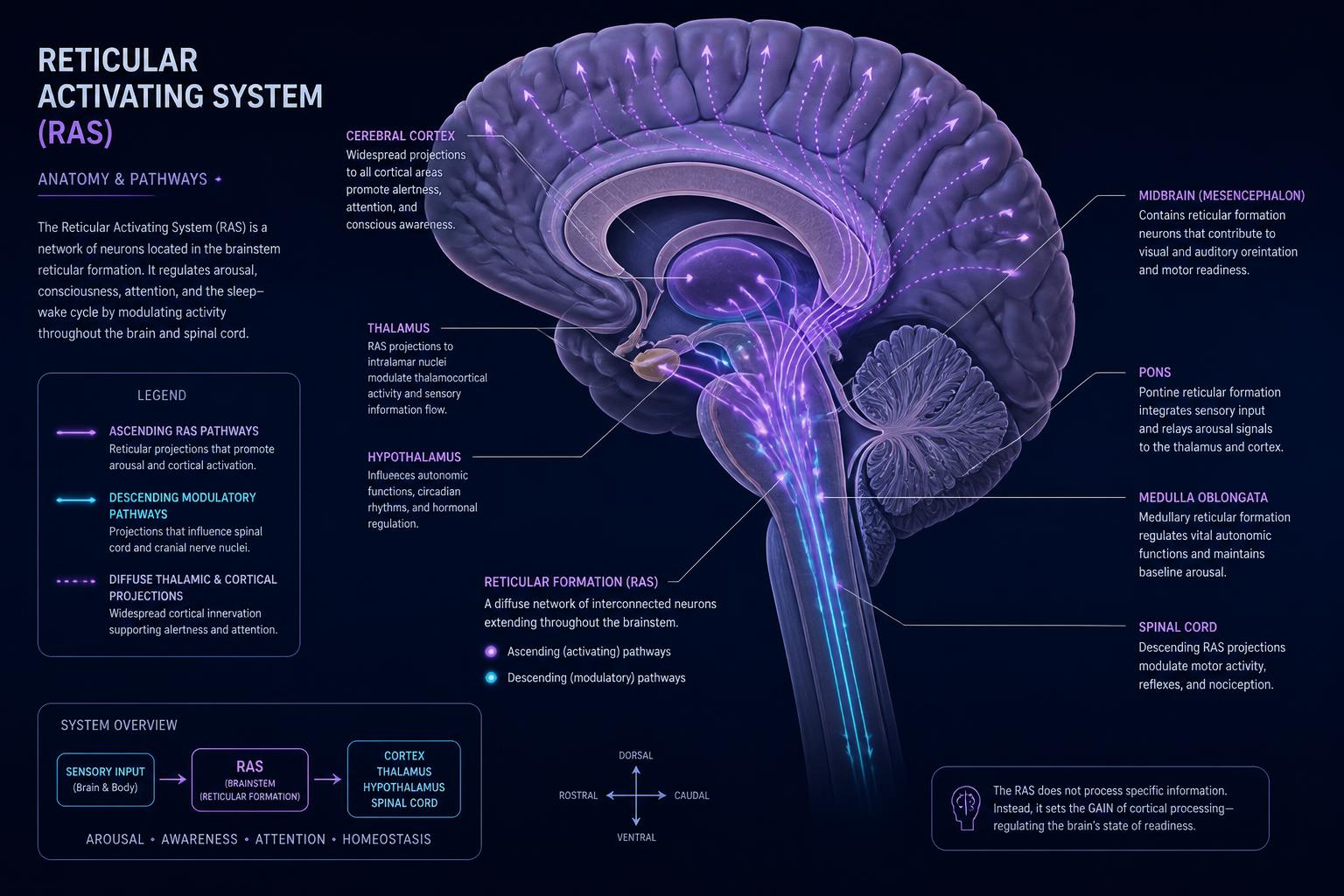
Sagittal schematic of the Reticular Activating System
Fig. 01 — Ascending & descending RAS pathways
§ Anatomy

A network, not a nucleus.

The Reticular Activating System is not a single organ but a diffuse mesh spanning the medulla, pons and midbrain, with critical hubs in the locus coeruleus, raphe nuclei, VTA and basal forebrain. It doesn't process what you see or hear — it decides whether you notice it at all.

~100M
Neurons routed
≈99%
Stimuli filtered
<300 ms
Wake latency
§ Function

Six roles. One master gate.

The RAS sets the brain's overall gain — its readiness to receive, prioritise and act on information.

01

Wakefulness & Arousal

The master switch that keeps you conscious. Damage here causes coma; over-activation causes insomnia.

02

Sensory Gating

Filters roughly 99% of incoming stimuli. What passes through becomes your conscious experience.

03

Selective Attention

The 'red car effect' — whatever you flag as important, the RAS begins spotting everywhere.

04

Sleep–Wake Cycle

Coordinates transitions between wake, NREM and REM by modulating cortical arousal.

05

Autonomic Regulation

Links to heart rate, breathing and stress via descending pathways to the spinal cord.

06

Cognitive Priming

Sets the 'gain' of cortical processing — the volume on the thoughts and goals you focus on.

The auditory nerve feeds directly into the reticular formation — no cortical thinking required. That is why frequency entrainment works below conscious effort.

— On the shortest path to the brainstem

§ Neurochemistry

Six messengers. Every mental state.

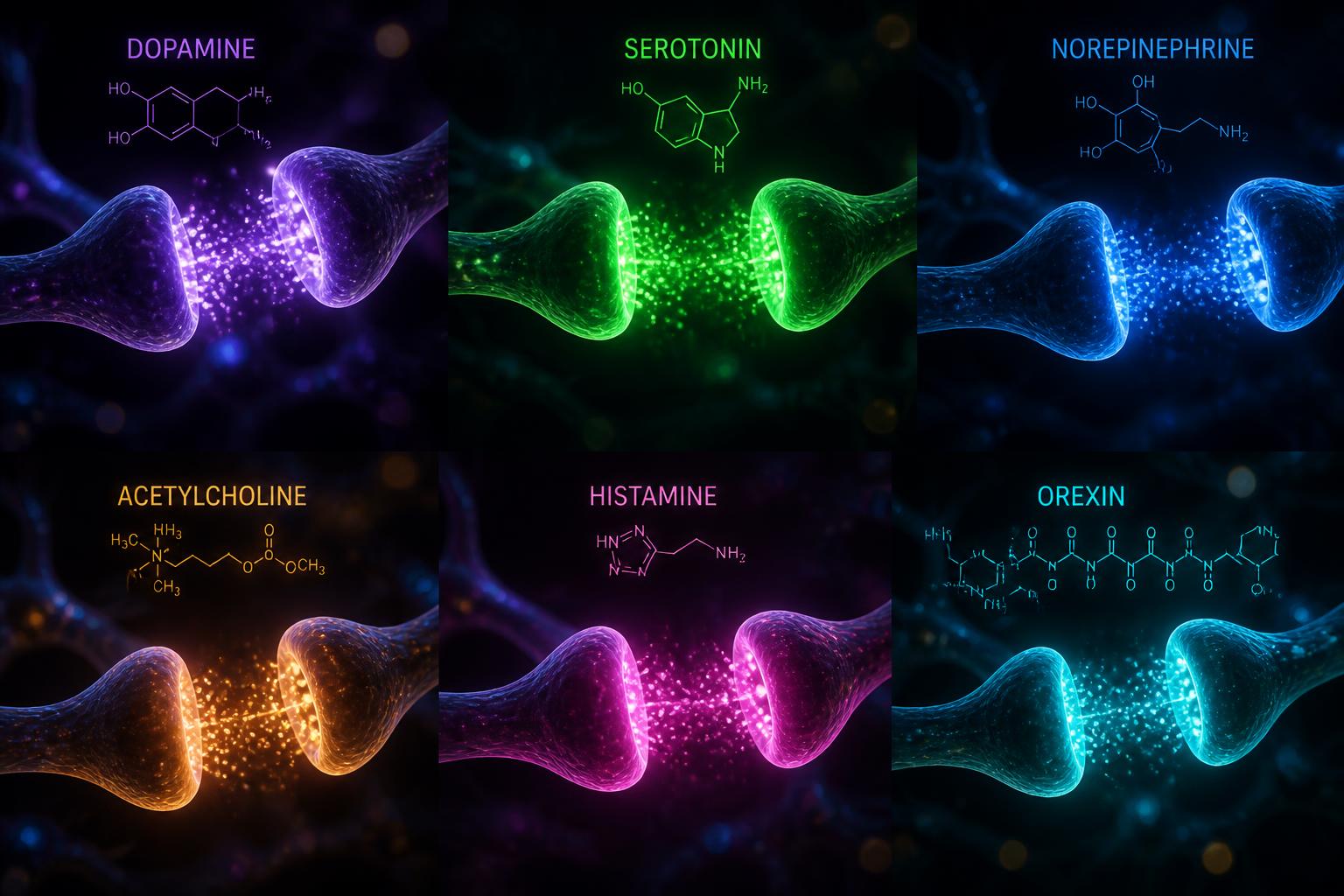
The RAS speaks in chemistry. Each frequency protocol nudges specific neurotransmitters — a 40 Hz Gamma session lights up dopamine and acetylcholine while a 2 Hz Delta session drops you into serotonergic calm.

ACh
Acetylcholine
Basal Forebrain, PPN
Attention, learning, REM sleep
NE
Norepinephrine
Locus Coeruleus
Alertness, vigilance, stress
5-HT
Serotonin
Raphe Nuclei
Mood, sleep, arousal
DA
Dopamine
Ventral Tegmental Area
Motivation, reward, focus
HA
Histamine
Tuberomammillary N.
Wakefulness, arousal
OX
Orexin
Lateral Hypothalamus
Sustained wakefulness
Six neurotransmitters at the synapse
Fig. 02 — Modulatory neurotransmitters of the RAS
§ Bands

Five bands. One trainable filter.

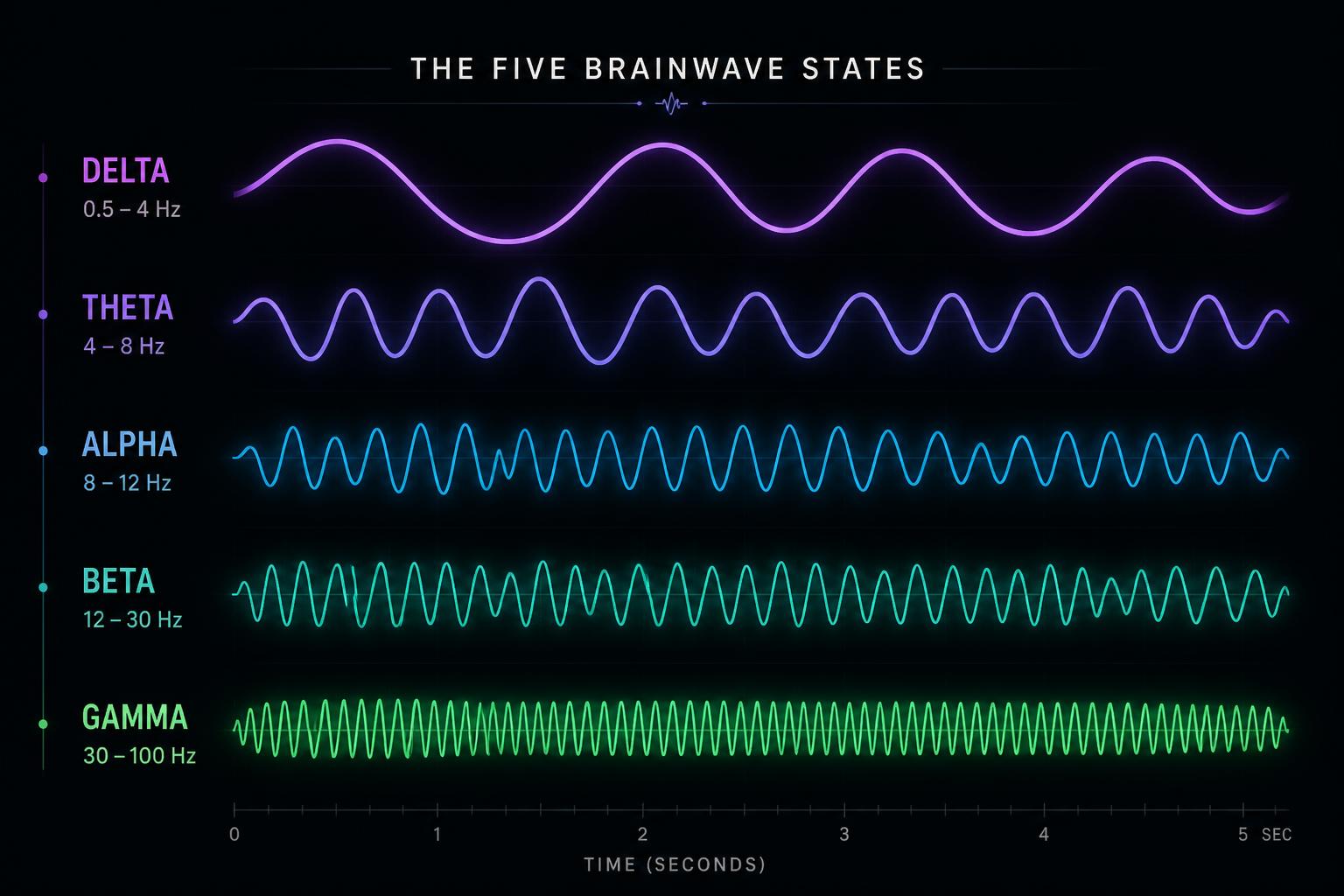
Every mental state has a signature frequency. Entrainment pulls the brain toward a target band using binaural beats and isochronic pulses — the frequency-following response.

Chart of the five brainwave states
0.5 – 4 Hz

Delta

Deep sleep, tissue repair, immune reset.

4 – 8 Hz

Theta

Meditation, hypnagogia, subconscious access.

8 – 13 Hz

Alpha

Relaxed alertness, flow states, integration.

13 – 30 Hz

Beta

Analytic focus, problem-solving, engagement.

30 – 100 Hz

Gamma

Peak cognition, insight, cross-modal binding.

§ Peer-reviewed foundation

The paper that anchors everything we build.

Waking and the Reticular Activating System — the NIH-indexed neuroscience review that maps the anatomy, neurochemistry and clinical relevance of the RAS. Every protocol, frequency and program in RAS BioHacker is built on the mechanisms described in this paper.

Citation
García-Rill, E. et al.
Waking and the Reticular Activating System in Health and Disease.
NIH / PMC · nihms-394960
§ Applied research

10 evidence-based ways to activate your Reticular Activating System.

The Reticular Activating System is a powerful neural network that plays a crucial role in cognitive function. You've likely experienced it without realising — noticing a car model everywhere after considering buying it, or picking up your name in a crowded café. These aren't coincidences; they're the RAS filtering information by relevance and importance.

The neuroscience behind the RAS

Located in the brainstem, this complex network of neuronal circuits regulates arousal, consciousness and attentional focus. The RAS acts as a sophisticated gatekeeper — sifting through the constant barrage of sensory stimuli and deciding what reaches your conscious awareness. Recent neuroimaging shows tight connectivity between the RAS and the prefrontal cortex, the basis for selectively attending to what matters while filtering out distraction.

01

Precision goal-setting

Clear, specific objectives program the RAS to be on high alert for relevant information and opportunities. Use the SMART+P framework: Specific, Measurable, Achievable, Relevant, Time-bound, Positive. Craft 3–5 goals; review weekly.

02

Multisensory visualisation

Basic visualisation helps; multisensory imagery amplifies it. Engage sight, sound, smell, texture and taste around your goals. A daily 15-minute session strengthens the neural pathways the RAS uses to prioritise stimuli.

03

Dynamic vision board

Static boards remind; dynamic ones engage. Use digital or AR tools that add motion, sound and interactivity. Update it regularly and interact with it daily for at least 5 minutes.

04

Focused-attention meditation

Focused-attention practices (Trataka, Samatha) specifically train the neural pathways of selective attention. Begin with 10 minutes daily, focusing on a single object or sensation and gently returning when the mind wanders.

05

Neurolinguistic programming

Anchoring and reframing create strong associative links, tuning the RAS toward goal-relevant stimuli. Anchor a positive state (e.g. touching thumb and forefinger) and trigger it deliberately.

06

High-Intensity Interval Training (HIIT)

HIIT stimulates neurotrophic factors that support RAS function. Its alternating high/low bursts mirror the RAS's own phasic activation. Aim for 2–3 sessions of 20 minutes weekly.

07

Optimise sleep architecture

Sleep consolidates information and resets attentional mechanisms. Prioritise slow-wave sleep with a consistent schedule (7–9 hrs) and a cool, dark, quiet environment.

08

Specific gratitude

Detailed gratitude trains the RAS to notice positive stimuli. Journal three specific experiences daily, described in sensory-rich detail.

09

Binaural beats & brainwave entrainment

Binaural beats modulate brainwave patterns via the frequency-following response. Alpha-range frequencies (8–12 Hz) support focus and attention — the exact mechanism RAS BioHacker's studio uses.

10

Intermittent fasting

Emerging research links intermittent fasting to enhanced neuroplasticity and attentional control. Consult a professional, then trial a 16/8 schedule 2–3 days per week.

A holistic approach

Activating the RAS is not one-size-fits-all. These techniques work synergistically and compound over time. Integrate them and expect gains not just in focus and awareness, but in creativity, decision-making and overall cognitive performance.

Train the filter. Change the feed.

Put on headphones, pick a protocol, and let sound do what thought alone can't.